


Yes. We’re currently accepting new in-person clients on Mondays, evenings 5–8pm, at our Wellesley Hills office.

Sleep Medicine · Psychiatric Care
Obstructive Sleep Apnea (OSA) Treatment
Loud snoring, gasping awake, and daytime exhaustion aren’t just “bad sleep” — they can be signs of obstructive sleep apnea (OSA), a common but serious breathing-related sleep disorder. Dr. Amit Chopra, MD — a dual board-certified psychiatrist and sleep medicine specialist — offers evaluation, sleep study referral, and a full range of OSA treatment options, from CPAP to oral appliances to emerging medical therapies.
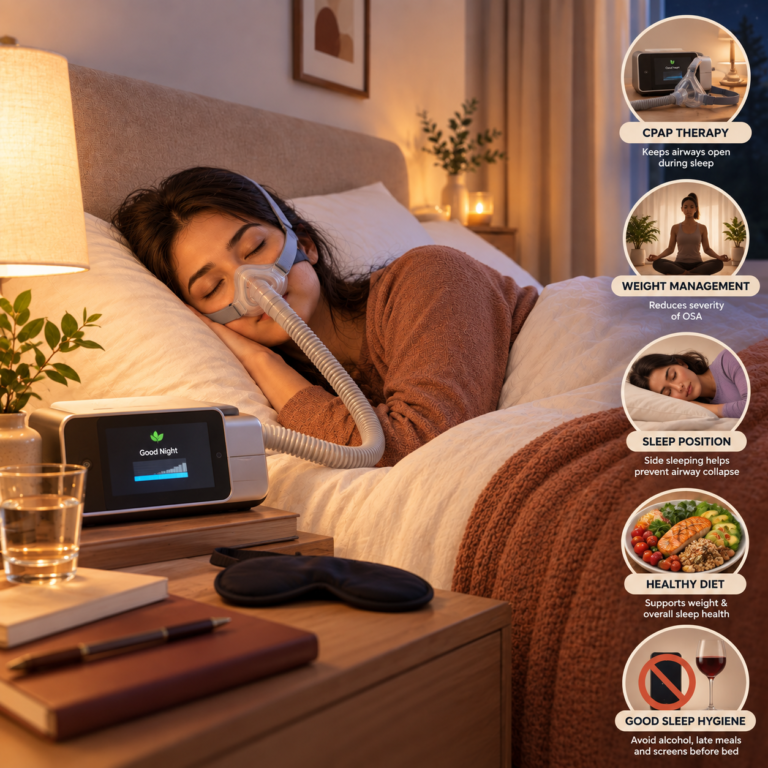
Sleep study referral — Polysomnography (PSG) when OSA is suspected
CPAP + alternatives — Oral appliances, positional therapy, and more
Evening hours — In-person at our Wellesley Hills office
OSA Treatment in Wellesley Hills, MA
What is OSA (obstructive sleep apnea)?
OSA — the osa medical abbreviation for obstructive sleep apnea — is a breathing-related sleep disorder in which the airway becomes partially or fully blocked repeatedly during sleep, causing breathing to stop and restart throughout the night. In plain terms: it’s a sleep disorder in which breathing is interrupted, often dozens or hundreds of times a night, without the person ever fully waking up to remember it.
People often ask “what does OSA stand for,” “what is OSA in medical terms,” or “what is the osa meaning medical” — the answer is the same condition: airway obstruction during sleep leading to pauses in breathing (apneas) or shallow breaths (hypopneas). It’s sometimes written as OSAS (obstructive sleep apnea syndrome) or confused with OMAS or OHS (obesity hypoventilation syndrome), which is a related but distinct condition.
So — is obstructive sleep apnea the same as snoring? Not quite. Snoring is a symptom, not a diagnosis. Someone can snore without having OSA, and some people with OSA barely snore at all (osa without snoring). The difference between OSA and simple snoring comes down to whether breathing is actually being obstructed and interrupted, which is why a sleep study — not snoring alone — is used for osa diagnosis.
Why choose Zen Minds for OSA treatment
Dual expertise
Dr. Chopra is a psychiatrist and sleep medicine specialist at Massachusetts General Hospital and Assistant Professor of Psychiatry at Harvard Medical School — equipped to treat both the breathing disorder and any anxiety, depression, or mood impact it’s causing, in one place.
We diagnose, not guess
From STOP-BANG screening through sleep study referral, we identify your actual AHI and severity before recommending CPAP, an oral appliance, or anything else — not a one-size-fits-all default.
The full range of options
CPAP, APAP, BiPAP, oral appliances, positional therapy, and — where relevant — GLP-1 medication or surgical referral, discussed honestly rather than steering everyone to the same device.
In-person & flexible scheduling
In-person sessions at our Wellesley Hills office, with evening appointments available for patients balancing work or school.
Signs & Symptoms of OSA
Common symptoms of obstructive sleep apnea
Classic symptoms of obstructive sleep apnea and general signs of sleep apnea to watch for include:
- Loud, chronic snoring — with or without witnessed pauses in breathing
- Excessive daytime sleepiness despite a full night in bed
- Difficulty concentrating, irritability, or mood changes
- A partner reporting you stop breathing while asleep
- Gasping, choking, or snorting awake during the night
- Morning headaches, dry mouth, or a sore throat on waking
- Waking up frequently to urinate during the night
- High blood pressure that's difficult to control
Symptoms of untreated sleep apnea tend to worsen gradually — which is why so many people live with obstructive sleep apnea for years before a diagnosis. If a partner has ever said “you stopped breathing while sleeping” or you find yourself asking “how would I know if I have sleep apnea,” that alone is reason enough for an evaluation.
What Causes OSA
Causes & risk factors for obstructive sleep apnea
OSA pathophysiology comes down to airway anatomy and muscle tone: during sleep, the muscles supporting the soft tissue at the back of the throat relax. In OSA, that relaxation causes the airway to narrow or collapse, producing an airway blockage during sleep. The most common risk factors for OSA include:
Excess weight
BMI and obstructive sleep apnea are closely linked — extra tissue around the neck and throat narrows the airway
Airway & jaw anatomy
A naturally narrow airway, large tonsils, or a recessed jaw increase risk regardless of weight
Age & sex
Risk rises with age, and OSA is more common — and more often underdiagnosed — in men, though it affects women too
Family history
Certain prescriptions or medical conditions affecting sleep
Nasal congestion
Chronic nasal congestion or a deviated septum can worsen airway obstruction during sleep
Alcohol & sedatives
These relax throat muscles further, making airway collapse more likely
Smoking
Increases airway inflammation and fluid retention in the upper airway
Sleep position
Positional OSA — apnea that’s worse lying on your back — is common and often treatable with positional therapy alone
OSA Severity
Mild, moderate, and severe OSA — what the AHI means
Severity is measured using the AHI (apnea-hypopnea index) — the average number of breathing pauses per hour of sleep, scored during a sleep study. This is what determines whether OSA is classified as mild, moderate, or severe, and it shapes which treatment we recommend.
AHI 5–14
Mild OSA
Often managed with positional therapy, weight management, and lifestyle changes for obstructive sleep apnea before escalating to a device.
AHI 15–29
Moderate OSA
Typically treated with CPAP or an oral appliance, often alongside the same lifestyle measures used for mild cases.
AHI 30+
Severe OSA
Usually requires CPAP or BiPAP therapy; untreated severe OSA carries meaningfully higher cardiovascular risk.
Patients often ask whether OSA can be cured outright. For many, the honest answer is that it’s highly manageable rather than “cured” in the way an infection is cured — though weight loss, positional therapy, or surgery can significantly reduce or, in some cases, resolve mild to moderate cases.
How OSA Is Diagnosed
Sleep studies, screening tools & diagnostic criteria for OSA
How is OSA diagnosed? Every evaluation starts with a conversation about your symptoms, health history, and — where possible — input from a bed partner, followed by objective testing:
STOP-BANG screening
A quick questionnaire (snoring, tiredness, observed apnea, blood pressure, BMI, age, neck size, gender) used to flag who needs a sleep study
Epworth Sleepiness Scale
A short screening tool measuring how likely you are to doze off during everyday activities
In-lab sleep study (PSG)
Overnight polysomnography — the gold-standard OSA test, tracking breathing, oxygen, and brain activity
At-home sleep study
A simplified at-home sleep study for sleep apnea, appropriate for many — though not all — suspected cases
Patients often ask whether OSA can be cured outright. For many, the honest answer is that it’s highly manageable rather than “cured” in the way an infection is cured — though weight loss, positional therapy, or surgery can significantly reduce or, in some cases, resolve mild to moderate cases.
OSA Treatment Options
How to treat obstructive sleep apnea
There’s no single best way to cure sleep apnea — the right OSA treatment depends on severity, anatomy, and what you can realistically stick with long-term.
CPAP & Airway Pressure Therapy
- CPAP (continuous positive airway pressure) — the first-line treatment for moderate to severe OSA
- APAP (auto-adjusting) and BiPAP for OSA when standard CPAP isn't tolerated
- Mask fitting — nasal, nasal pillow, or full-face — since comfort drives long-term use
- Support for common CPAP complaints: dry mouth, mask leaks, and claustrophobia
CPAP Alternatives
- Oral appliance therapy — a custom mouth device that repositions the jaw and tongue
- Positional therapy devices for those with positional OSA
- Neuromuscular tongue-training devices for select mild cases
- Referral for surgical options or hypoglossal nerve stimulation when appropriate
We’re often asked about specific CPAP alternatives and mouth devices for sleep apnea by brand name. We’ll discuss honestly which category of device fits your anatomy and severity — and refer you to an appropriate specialist for fitting and follow-up when a device falls outside our in-house services.
Weight, GLP-1s & OSA
Weight loss, GLP-1 medications, and OSA
Because BMI and obstructive sleep apnea are closely linked, weight loss is one of the most effective non-device interventions for many patients. This has put a spotlight on GLP-1 medications: patients frequently ask whether tirzepatide helps with sleep apnea, and clinical trial data (including the SURMOUNT-OSA trial) has shown meaningful AHI reduction with tirzepatide in patients with obesity and moderate-to-severe OSA. Semaglutide and OSA, and to a lesser extent retatrutide and sleep apnea, are also active areas of research.
As psychiatric and sleep medicine providers, we can discuss whether a GLP-1 medication makes sense as part of your overall OSA management plan — alongside, not instead of, CPAP or an oral appliance where one is still needed.
Left Untreated
Is OSA dangerous? Complications of untreated sleep apnea
Is sleep apnea a respiratory disorder with only nighttime consequences? No — untreated OSA is linked to a meaningfully higher risk of several serious conditions:
- High blood pressure and other cardiovascular strain
- Increased risk of stroke and heart attack over time
- Daytime accidents from excessive sleepiness, including while driving
- Atrial fibrillation and other heart rhythm problems
- Type 2 diabetes and insulin resistance
- Worsened mood, anxiety, or depression symptoms
Can you die from OSA directly? Rarely in a single night — but the cumulative cardiovascular and metabolic strain of chronic, untreated OSA is where the real long-term danger lies, which is exactly why early diagnosis and consistent treatment matter.
OSA in Children & Special Populations
Pediatric OSA, and OSA in women
Children & toddlers
Obstructive sleep apnea in kids and pediatric OSA often looks different from adult OSA — enlarged tonsils and adenoids are common causes, and pediatric obstructive sleep apnea treatment frequently starts with an ENT referral.
Teens & young adults
Sleep apnea in teenagers is under-recognized and often mistaken for simple daytime tiredness or attention problems at school.
Women
OSA symptoms in women can be subtler than the “classic” loud-snoring presentation seen in men — more often fatigue, insomnia, or mood symptoms — which contributes to underdiagnosis.
Are You a College Student?
The Zen Minds Student Psychiatry & Sleep Program
Anxiety, ADHD, depression, and sleep struggles often surface during college — and campus counseling centers are booking one to two weeks out. Get seen in 5–7 business days, with care built specifically for college and graduate students.
We welcome referrals for medication management, ADHD evaluation, or sleep concerns outside your team’s scope — and with the student’s consent, we’ll stay in touch so nothing falls through the cracks.
Meet the founder
Dr. Amit Chopra, MD
Most Boston psychiatrists treat the mind. Dr. Amit Chopra treats the mind and the sleep behind it. A dual board-certified psychiatrist and sleep medicine specialist, Assistant Professor of Psychiatry at Harvard Medical School, and practicing psychiatrist at Massachusetts General Hospital, Dr. Chopra trained at the Mayo Clinic and has presented specifically on ADHD and sleep disorders in young adults to the American Society for Adolescent Psychiatry.
He founded Zen Minds Psychiatry — and built the Student Psychiatry & Sleep Program specifically — because the students who need psychiatric care most are often the ones with the least time to wait for it.

Hear From Our Clients
From patients who found their sleep again
“I’ve been seeing Dr. Chopra for 3 years now, and he has been really helpful. He is kind, listens, is thoughtful, and always responds quickly to my messages. Being a sleep specialist has been really beneficial in helping me treat my sleep disorders.”
— LT, patient for three years
After a 2024 sleep study, Dr. Chopra diagnosed and treated a sleep disorder I’d struggled with since childhood. He thoughtfully adjusted my treatments to improve my daytime cognition while considering my other health conditions.
— JH, patient for two years
Frequently Asked Questions (FAQ)
What does OSA stand for?
OSA stands for obstructive sleep apnea — a sleep disorder in which the airway becomes repeatedly blocked during sleep, interrupting breathing.
What is the difference between OSA and sleep apnea in general?
Sleep apnea is the broader category; OSA (obstructive) is the most common type, caused by physical airway blockage. Central sleep apnea, a less common type, is caused by the brain not signaling the breathing muscles correctly.
What are the classic symptoms of obstructive sleep apnea?
Loud snoring, witnessed pauses in breathing, gasping awake, morning headaches, and excessive daytime sleepiness are the most common signs.
How is OSA diagnosed?
Through a combination of symptom screening (such as STOP-BANG or the Epworth Sleepiness Scale) and a sleep study — either in-lab polysomnography or an at-home sleep study — which measures your AHI.
Can OSA be cured, or only managed?
Mild to moderate OSA can sometimes be significantly improved or resolved through weight loss, positional therapy, or surgery. Moderate to severe OSA is generally managed long-term with CPAP or an oral appliance rather than “cured” outright.
What's the difference between mild, moderate, and severe OSA?
Severity is based on your AHI (apnea-hypopnea index) from a sleep study: mild is roughly 5–14 events per hour, moderate 15–29, and severe 30 or more.
Are there CPAP alternatives?
Yes — oral appliance therapy, positional therapy devices, and in some cases surgery or hypoglossal nerve stimulation are all options, depending on your anatomy and severity.
Does weight loss help with OSA?
Often significantly, since BMI and obstructive sleep apnea are closely linked. GLP-1 medications like tirzepatide have also shown meaningful AHI reduction in clinical trials for patients with obesity-related OSA.
Is obstructive sleep apnea dangerous if left untreated?
Yes — untreated OSA is linked to higher long-term risk of high blood pressure, atrial fibrillation, stroke, heart attack, and type 2 diabetes, in addition to daytime sleepiness and accident risk.
Can children have obstructive sleep apnea?
Yes — pediatric OSA is more common than many parents realize, often caused by enlarged tonsils or adenoids, and is usually evaluated jointly with an ENT specialist.